Every December, without really thinking about it, we do something quietly extraordinary: we buy small rectangles of card, scribble warm wishes on them, and send them flying across countries and oceans to the people we love. It feels like it must always have been this way. It hasn’t. The Christmas card is an invention — a Victorian one, born of a busy man’s embarrassment, a postal revolution, and some of the most beautiful commercial artwork the nineteenth century ever produced. And its history hides a few surprises. Not least: Santa Claus used to wear blue.
The first Christmas card was an act of desperation
London, 1843. The Victorian postal system was in the middle of a transformation. Three years earlier, reforms championed by Rowland Hill had introduced the Uniform Penny Post — for a single penny, a letter could travel anywhere in the British Isles. Suddenly, for the first time in history, ordinary people could afford to write to each other constantly. And they did. Seasonal greetings poured through the letterboxes of the well-connected, and answering them by hand became a genuine social burden.
Sir Henry Cole knew this burden well. A civil servant, educator, design reformer and founding director of what became the Victoria and Albert Museum, Cole was a man of enormous energy and correspondingly enormous correspondence. The story goes that in the run-up to Christmas 1843, confronted with a stack of unanswered letters, he had an idea as efficient as it was charming: why not commission a single greetings message, have it printed, and sign it many times over?
He turned to his friend, the Royal Academician John Callcott Horsley, who designed a triptych: a family raising a toast in the centre, flanked by scenes of the poor being fed and clothed. “A Merry Christmas and a Happy New Year to You” ran the greeting, simple and durable enough that we still say it today. A thousand copies were printed and sold for a shilling each — expensive for the time, and at first the card was mocked by some as a lazy shortcut. But the idea was unstoppable. By coincidence, 1843 was also the year Charles Dickens published A Christmas Carol; between them, Cole’s card and Dickens’s ghost story effectively invented the modern commercial Christmas.
The golden age of the Christmas card
The real explosion came in the following decades, when cheap printing — above all chromolithography, which laid down layer upon layer of brilliant colour — met an ever-cheaper postal service. By the 1870s, the halfpenny post rate made sending a card almost free, and the Christmas card industry boomed. Between the 1870s and the 1910s, card publishers commissioned thousands of designs every year from the finest illustrators of the day, turning the seasonal greeting into an art form in miniature. These small pictures carried the whole Victorian and Edwardian imagination of Christmas: pine and holly, church spires under snow, stagecoaches struggling through drifts, robins, plum puddings, angels, children sledging — a whole idealised winter world, printed on card for the price of a stamp.
It is from this golden age that the designs in our collection of Christmas greetings cards come. A Snowball and Church Scene card from 1911 captures the era perfectly: a snowball fight in the foreground, a village church glowing behind the snow — the nostalgic rural Christmas the Edwardians were already beginning to long for, even in 1911. A Christmas card from 1913 from the following years carries the same warmth in its period detail, while a angel and Christmas scene card belongs to one of the oldest and loveliest traditions of all: the Christmas angel, watching over the sleeping winter world.
Why is Santa red? He didn’t used to be
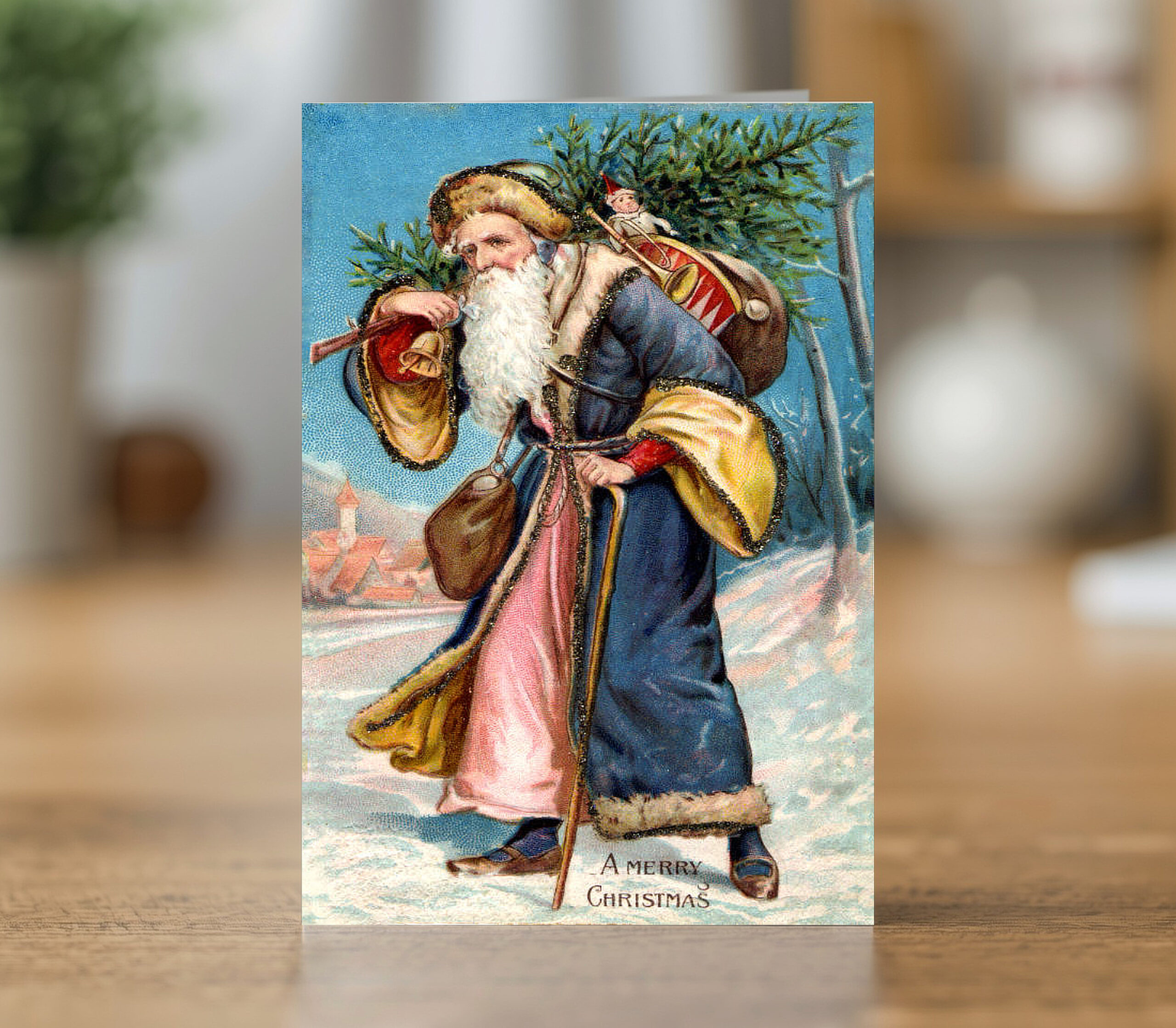
And then there is the fourth card — a Santa with a Christmas tree and a sack of gifts — with a detail that stops people mid-glance. Santa is wearing blue.
This is not a printing error, and it is not a designer’s whim. It is history. Santa Claus descends from St Nicholas, a fourth-century bishop of Myrna whose liturgical robes were traditionally depicted in red, but whose appearance in popular art wandered freely for centuries. Early American images of “St. Nick” drew on the Dutch Sinterklaas and showed him in every colour an illustrator fancied. When Thomas Nast began drawing Santa for Harper’s Weekly in the 1860s — establishing the rotund, jolly figure we know today — he dressed him variously in tan, green, blue, and brown furs, as well as red. Victorian and Edwardian Christmas cards, the very cards we have been looking at, show Father Christmas and Santa in blue robes, green cloaks, white coats, even brown blankets. The red suit was winning by the early twentieth century, helped along by the growing association of red and green as the Christmas colours, but it was not yet inevitable.
What made it inevitable, in the popular imagination, was Coca-Cola. Between 1931 and 1964, the illustrator Haddon Sundblom painted Santa for the company’s Christmas advertising: a warm, grandfatherly figure, endlessly delivering and drinking the product — dressed, decisively, in red. Sundblom did not invent red Santa, and Coca-Cola never claimed to; the colour had been converging on the character for decades. But those paintings fixed the image so completely that the many-coloured Santa of the nineteenth century was almost erased. When we look at our blue-robed Santa today, we are looking through a window at that older, stranger, more wonderful Christmas — the one where Father Christmas had not yet chosen his colours.
Which is exactly what makes a reproduction like this such a conversation piece: send it to someone this Christmas, and watch them do a double-take at the blue robes before you get to tell them the story.
A small rectangle of history
From Henry Cole’s stack of unanswered letters to a worldwide seasonal ritual, the Christmas card has survived the telegram, the fax, and — so far — the emoji. There is still nothing quite like the ritual of choosing a card for a particular person, writing something by hand, and sending it out into the December cold to arrive on a doormat a few days later.
Our Christmas greetings cards reproduce these golden-age designs as new, printed-to-order reproductions — blank inside, ready for your own words, in two paper stocks and two sizes, as singles or packs for the whole card list. Browse the full collection of greetings cards, and give someone a small rectangle of history this Christmas.